
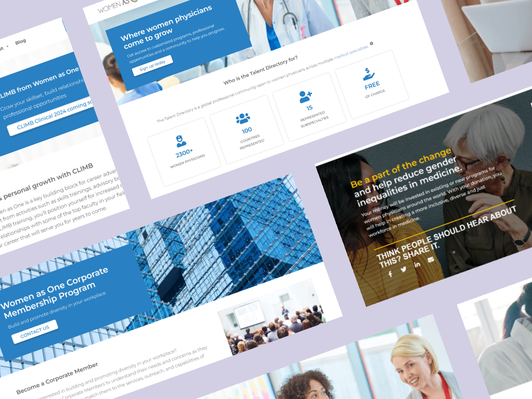
I joined Women as One as its first dedicated marketer at a point where the organisation already had traction: successful programmes, a growing community, sponsors and partners, and an early digital product. The challenge was not to invent demand from nothing. It was to build the marketing, growth and operating capability required to turn that traction into something the organisation could scale.
The business situation
Women as One supports women in cardiology through education programmes, awards, community initiatives and its Talent Directory platform.
When I joined, the organisation already had things people wanted. What it did not yet have was a marketing function capable of supporting them consistently.
There was:
- no dedicated marketing employee;
- no shared marketing strategy or operating cadence;
- limited reporting and attribution;
- campaigns managed largely as individual projects;
- scattered tools and accounts;
- no formal marketing team structure;
- limited internal processes for digital collaboration.
At the same time, marketing was expected to contribute to several different business objectives:
- recruit participants into education programmes;
- attract applicants into awards and grants;
- support sponsors and partners;
- grow the global community;
- expand visibility in the US and internationally;
- increase adoption and value of the Talent Directory;
- create stronger digital infrastructure for the organisation itself.
Company scale: Women as One reported $1,827,541 in FY2023 revenue in its IRS Form 990. My engagement ended in February 2023, so I use that figure only as context for the organisation's scale, not as revenue attributable to my work.
The real constraint
The organisation did not primarily have a channel problem.
It had a growth-capacity problem.
Successful programmes created more campaigns. More campaigns created more tools, data and coordination. More people required clearer ownership and better collaboration. Growing the Talent Directory exposed questions about the product itself.
The role therefore evolved according to whatever was constraining the next stage.
Decision 1: Don't wait for the function to exist before generating growth
I could not spend six months designing the perfect marketing organisation while programmes still needed participants. So I built the function while running the work.
For programmes such as CLIMB and the Escalator Awards, I moved away from treating every launch as a completely separate campaign.
The reusable logic became:
- audience
- message
- distribution
- landing page
- conversion
- follow-up
- reporting
The execution changed by programme but not the underlying machinery.
An early CLIMB campaign period produced:
- +41.06% users versus the previous period;
- social becoming the #1 acquisition channel at 39% of site traffic, up from 5.2%;
- 1,205 CLIMB pageviews in the tracked week;
- 74,901 social reach;
- a broader international audience across markets including Argentina, Germany, Spain, Japan, India and Libya.
Post-campaign reporting later showed +133% site traffic and +150% pageviews YoY, with particularly strong audience growth in Africa, Asia and Europe. The point was not the channel mix itself. It was that acquisition was becoming measurable and reusable while the wider function was still being built.
Decision 2: Treat programme growth as a business outcome, not a traffic outcome
The Escalator Awards required both applicant acquisition and credible sponsor reporting. The 2021 programme generated:
- 53 applications from 12 countries;
- 11 laureates;
- $355,000 distributed;
- 4 papers published;
- 6 manuscripts submitted;
- 3 ACHD fellowship grants.
Sponsors included Amgen, Medtronic, Abbott, AstraZeneca, Bristol-Myers Squibb and Philips.
This mattered because marketing was not just increasing visibility. It was helping programmes recruit the right people and giving sponsors a quantified view of what their funding enabled.
Decision 3: Don't treat every organisational problem as outside marketing
As activity increased, collaboration itself became a constraint. Files and information were fragmented across environments and individual accounts. That made execution, onboarding and shared ownership harder.
Rather than accept that as somebody else's IT problem, I led the organisation's Microsoft 365 migration.
I designed:
- the Teams and SharePoint architecture;
- information structure and nomenclature;
- migration logic;
- external support selection;
- shared ownership;
- training and onboarding.
This was not traditional campaign work. It was still a growth problem because a function cannot scale on top of fragmented operating infrastructure.
Decision 4: Don't keep acquiring users if the product itself needs work
The Talent Directory initially entered my scope as something marketing needed to grow. Usage and board-level product data showed that acquisition alone would not solve the underlying problem: the product had an international user base, but engagement and activation were not strong enough.
So the question changed from:
How do we promote the Talent Directory?
to:
What should the product become, and what would make it genuinely useful?
I combined:
- multilingual user surveys;
- group interviews;
- internal discovery interviews;
- usage analysis;
- product and commercial data.
The research informed positioning, mockups, a full PRD, four personas, roadmap priorities, vendor selection and board-level product decisions. By early 2023, the PRD referenced 1,850+ users across 95 countries, with around 94 monthly sign-ins. The Talent Directory was also receiving talent requests from organisations, showing that it was already creating value beyond individual member profiles.
The important point is not the volume of internal activity. It is that I moved from acquisition into product strategy when the evidence showed that improving the product itself was the more important growth lever.
Decision 5: Don't solve capacity by making one person's job infinitely larger
By 2022, programme acquisition, sponsor communications, reporting, product work, IT coordination and recruitment were running simultaneously.
Keeping all of that concentrated in one person would have recreated the exact dependency I was trying to remove.
So I designed the team before scaling execution.
I defined roles, responsibilities, job descriptions, salary ranges and onboarding. I recruited and onboarded the first marketing hire and supported recruitment for a VP Growth role.
The objective was not to become indispensable. It was to make the function less dependent on me.
What changed
| Before | After |
|---|---|
| No dedicated marketing function | Clear marketing ownership, strategy and operating cadence |
| One-off campaigns | Reusable acquisition models across programmes |
| Limited visibility into performance | Cross-channel and board-level reporting |
| Fragmented collaboration | Shared Microsoft 365 / Teams / SharePoint infrastructure |
| Marketing mainly promoting products | User research informing product decisions and roadmap |
| No team | First hires plus defined future organisation |
| Knowledge concentrated in individuals | Processes, training and documented handover |
Business and growth proof
The strongest evidence is distributed across several parts of the function:
- CLIMB: +41.06% users during an early campaign period; social traffic 5.2% → 39%; later +133% site traffic and +150% pageviews YoY.
- Escalator Awards: 53 applications across 12 countries; 11 laureates; $355K distributed.
- Talent Directory: 1,850+ users across 95 countries by early 2023, around 94 monthly sign-ins, and talent requests from organisations; user research and product data led to a new product direction, personas, PRD, roadmap and vendor selection.
- Commercial connection: the Talent Directory was also connected to corporate membership and partner use cases, so product decisions were tied to business value as well as community engagement.
What this case demonstrates
Women as One shows how I work when I enter early. I use marketing as the starting point, but I follow the constraint.
When acquisition needed structure, I built acquisition.
When collaboration blocked scale, I worked on operations.
When the product needed to change, I moved into research and product definition.
When my own capacity became the constraint, I built the team.
The job was to build what the organisation needed next to keep growing.