
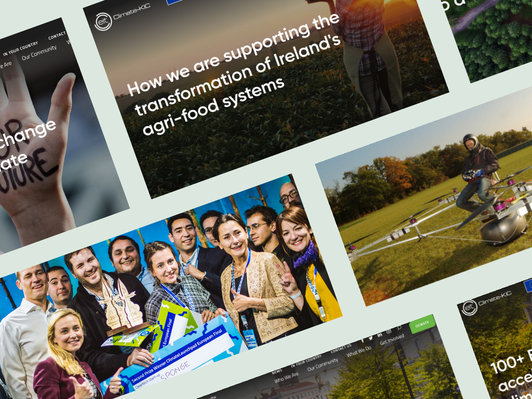
I joined Climate-KIC to lead digital marketing across five climate-innovation and education programmes. There was almost no conventional ramp-up: my manager was away for much of my first month, there was no meaningful onboarding process, and I had to reconstruct the programmes, teams, audiences and priorities largely by myself. Roughly two months later, a major organisational restructure was announced. Then COVID changed how some of those programmes could operate at all.
The starting point
Climate-KIC operated a portfolio of climate-innovation, entrepreneurship and education programmes across Europe and through an international partner network.
My remit covered five programmes simultaneously, with very different audiences:
- climate professionals and innovators;
- entrepreneurs;
- young people and students;
- local city organisers;
- citizens;
- institutional and ecosystem partners.
One programme might need hundreds of qualified applicants. Another depended on local organisers recruiting citizens. Another needed partners to advocate through their own networks.
Some required central campaign execution. Others needed central marketing to enable dozens or hundreds of people to execute locally.
This was a portfolio problem, not five versions of the same funnel.
There was no real onboarding runway
During the first month, I had to work out:
- what each programme actually did;
- what success meant for each team;
- who owned what;
- which audiences mattered;
- what had already been tried;
- where the deadlines were;
- which partners mattered;
- what activity was already in motion.
At the same time, climate innovation was a new domain for me. The ecosystem had its own terminology, institutions, funding structures, stakeholders and programme models.
I could not spend months becoming an expert before contributing.
I had to learn by operating.
Then the organisation changed
Approximately two months into the role, Climate-KIC announced a major restructure.
Teams and reporting structures began changing while programmes still had recruitment targets, campaign deadlines, partners and commitments.
COVID later introduced a second major disruption.
For physical programmes, the question stopped being:
How should we market the next edition?
and became:
How does the programme itself continue when its normal format is impossible?
The role became a continuous exercise in creating enough working clarity to keep delivery moving while the environment changed underneath it.
Decision 1: Don't build five completely separate marketing machines
With five programmes competing for attention, bespoke infrastructure for every team would have consumed all available capacity.
But forcing them all through the same strategy would have ignored important differences.
So I separated shared capability from programme-specific strategy.
Shared capability
- segmentation;
- campaign planning;
- reporting;
- paid and organic distribution;
- landing pages;
- partner toolkits;
- messaging frameworks;
- reusable content and brand assets.
Programme-specific strategy
- audience;
- proposition;
- channel mix;
- conversion objective;
- partner role;
- level of local autonomy.
That created leverage without pretending the programmes behaved identically.
Decision 2: Don't give every programme equal resources simply because every programme is important
Several teams could legitimately say their programme was urgent.
Marketing capacity could not expand every time a request arrived.
So part of the role became deciding:
- what required bespoke work;
- what could reuse an existing system;
- what programme teams could execute themselves;
- what required central marketing involvement;
- which activity would materially affect an outcome;
- what simply did not deserve additional attention.
That prioritisation was as important as the execution itself.
Decision 3: Don't optimise for cheap reach when the programme needs qualified participants
Pioneers into Practice needed to fill 700 seats across Europe with approximately €5,000 in paid-media budget.
With that constraint, there was no room for one broad campaign followed by retrospective learning.
I built four isolated targeting hypotheses and compared them while the campaign was live.
The Member Groups segment emerged as the strongest at approximately 1.1% CTR, so budget shifted toward the signal instead of waiting until the end.
The campaign generated:
- 1,200+ qualified leads;
- 700 programme seats filled;
- €2.65 CPC;
- approximately €7.14 in paid-media cost per filled seat.
The important decision was not choosing LinkedIn. It was building enough feedback into the campaign to reallocate scarce budget before it disappeared.
Decision 4: Don't centralise execution when the network is the distribution engine
Climathon operated through a large network of local organisers.
Central marketing could not execute every city campaign. Trying to do so would have destroyed the programme's biggest distribution advantage.
During a major global rebrand, I built the rollout so organisers could execute themselves using shared messaging, global assets, editable templates, guidance and campaign materials.
The model was:
central consistency + local autonomy
rather than central control.
The rollout reached 150+ cities within a 30-day deadline.
The first toolkit cycle generated:
- 185+ downloads;
- 3.2M social reach;
- 23 press articles;
- approximately 580K media reach.
Decision 5: Don't preserve the format if the format is no longer possible
COVID removed the physical model behind Climathon.
One option would have been to replace distributed local events with one central online event. Operationally, that would have been simpler.
It also would have removed local ownership, one of the programme's core strengths.
So the principle became:
change the format, preserve the value.
Local organisers received digital campaign assets, messaging, templates, communication guidance and amplification support.
They could then run local digital editions while remaining part of the global initiative.
The first fully digital Climathon brought together:
- 4,500+ citizen participants;
- across approximately 100 digital ideathon events;
- within a network spanning 100+ cities and roughly 50 countries.
Decision 6: Don't wait for organisational clarity before creating working clarity
The restructure meant reporting lines and ownership were changing while work still needed to move.
So I repeatedly had to establish enough practical clarity around individual projects:
- Who owns this decision now?
- Who actually needs to be involved?
- Which dependency is blocking execution?
- What can move without further approval?
- What can be simplified?
- What matters enough to protect despite the surrounding change?
The organisation did not always provide the structure first. Sometimes the project had to create its own temporary operating structure.
What I was really managing
Rapid domain learning
Becoming sufficiently fluent in an unfamiliar climate-innovation ecosystem to make credible decisions without a conventional onboarding period.
Constant context switching
Moving between professionals, entrepreneurs, organisers, citizens, partners and education audiences.
Portfolio prioritisation
Deciding which programmes and activities deserved limited marketing resources.
Central versus local execution
Knowing when marketing should execute directly and when the higher-leverage role was enabling others.
Organisational instability
Continuing to deliver through a restructure that started almost immediately after I joined.
External disruption
Adapting not just campaigns but programme delivery models during COVID.
What changed
| Starting constraint | Response |
|---|---|
| No meaningful onboarding | Self-directed mapping of programmes, stakeholders and priorities |
| Manager largely unavailable during first month | Rapid independent ramp-up |
| Five programmes competing for attention | Portfolio prioritisation and reusable infrastructure |
| Different audiences and conversion objectives | Programme-specific marketing motions |
| €5K acquisition budget | Segmented experimentation and live reallocation |
| 100+ distributed organisers | Self-service toolkits and modular assets |
| Global rebrand | 150+ city rollout in 30 days |
| Organisational restructure | Working systems despite changing ownership |
| COVID removed physical events | Distributed digital model preserving local ownership |
What this case demonstrates
Climate-KIC is not primarily a story about one acquisition campaign, one rebrand or one COVID pivot.
It demonstrates my ability to become useful quickly in an unfamiliar environment and continue making good decisions while that environment changes.
I entered with almost no onboarding. I had to understand five programmes largely through my own investigation. A restructure followed almost immediately. Then COVID changed the operating model of major programmes.
Throughout that, people still needed to be recruited, partners still needed support and teams still needed marketing decisions.
The recurring questions were:
What matters now? What deserves resources? What can be standardised? What needs to remain specific? What can others execute themselves? And what part of the model is valuable enough to protect when everything else changes?